#OutToLunch: Rampant unemployment is a key national security issue

By Denis Jjuuko

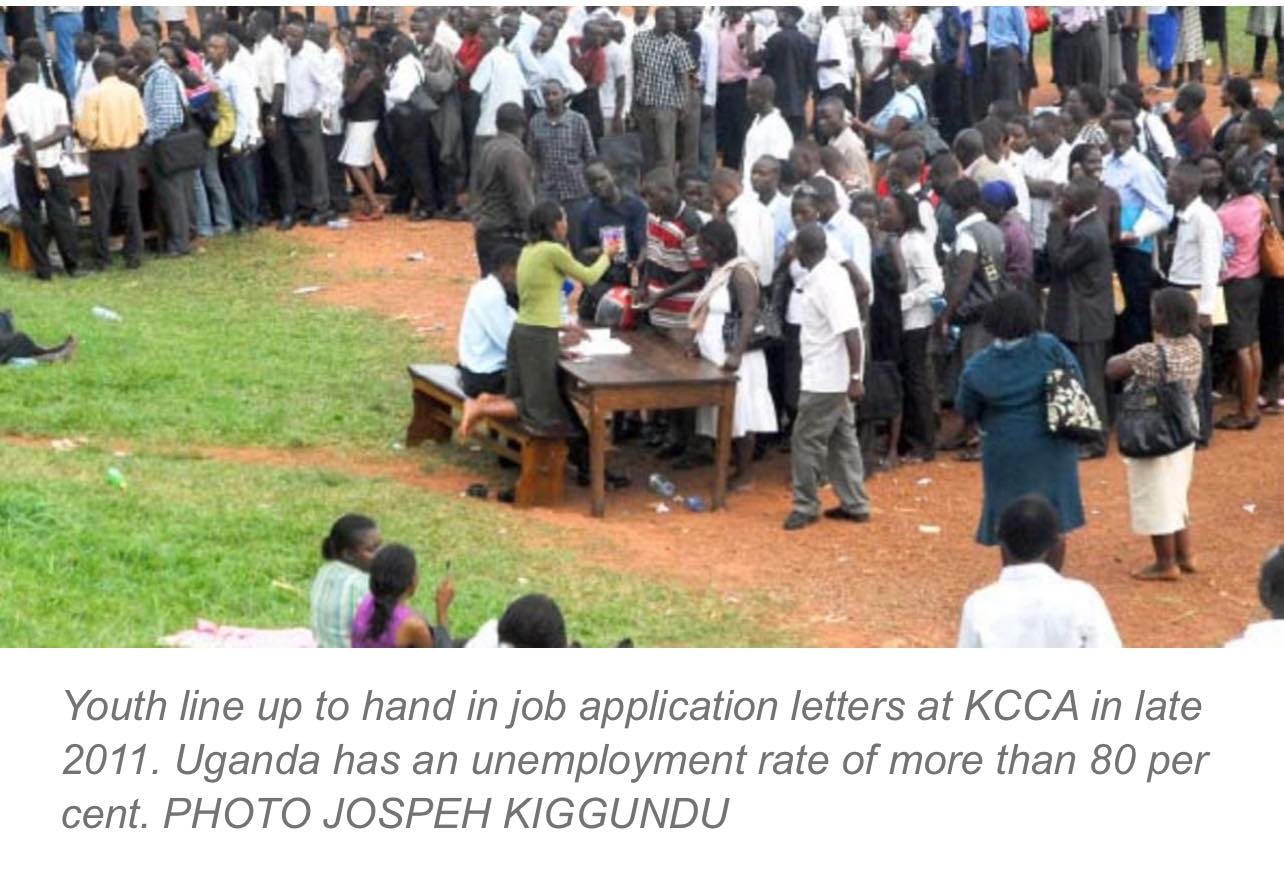
The public service ministry recently announced that more than 40,000 people applied for 287 jobs across different government ministries, departments and agencies. More than 28,000 of those who applied qualified, meaning they were selected for aptitude tests which were to be held at the Mandela National Stadium at Namboole. It must be frustrating looking for job in Uganda.

The news came after a bombshell report emanating from research by the Inspectorate of Government (IG) and the Economic Policy Research Centre (EPRC) that indicated that Ugandans pay a whopping Shs42.34b annually to district service boards to get jobs. Averagely, the report indicated, 130,000 people pay bribes to land jobs.

The people who ask for these bribes know that the jobs are scarce and people are desperate and willing to do anything to land the jobs. When somebody who bribed their way to a job gets employed, it means a few things.

First, the person is not the best for the job. They just had the money to pay a recruiter. The best candidate may not have had the money and therefore wasn’t considered. Because the person knows they only got the job through bribery, they will continue bribing their way into senior positions. That is how we end up with incompetent people in positions of authority. People who can’t execute anything and making sure things don’t work or looking at everyone who is competent as a threat or what people call work politics.

The people who are competent end up doing very little at work so that the incompetent boss doesn’t feel insecure and threatened. That is how we end with yes people—they won’t advise their bosses. They will do whatever the boss wants whether it makes sense or not. Remember, there are no jobs and these people have families to feed. Rocking the boat isn’t something that they want to do.

Second, the people who bribed their way to jobs will only hire those who pay them a bribe. That way you end up with a corrupt layer at every level and an incompetent lot everywhere. Service delivery is impacted. Government then fails to create jobs that young people can apply for and get on merit.

Third, because the public service is corrupted, the private sector suffers too. People can’t start and run businesses professionally. The people who are in positions because they paid a recruiter will endlessly try to get a return on their investment (read bribe). Procurement processes will be compromised. Payment for services and goods delivered will be frustrated unless somebody is paid.

The bribery doesn’t end at public service. We recently saw many statements from politicians who lost elections for positions in their political parties claiming their rivals won through bribery. Some wondered why people were bribing for positions that were actually “voluntary.”

We hear that candidates for Members of Parliament in some constituencies spend more money than they would get in the five years they would spend in the office should they win. If somebody spends more money than they would be officially paid, it means they are doing so to illegally get something. Somebody who sells their house to get money for election will do anything to get their house back.

That is how we end up without jobs and seeing young energetic people leaving the country for the Middle East not to do highly technical jobs but menial ones or being trafficked for sex like we recently heard from a BBC investigation.

Government has been saying that they are intending to grow the economy to US$500 billion annually. Great stuff but with rampant corruption, it will be a tall order. There is a need to nip corruption in the bud in order to create sustainable jobs for the working age population.

Otherwise, we shall continue to see thousands of people filling up soccer stadiums to apply for a few jobs they know they stand no chance of getting. That is what they call desperation. And desperate people can do pretty much anything. Unemployment ends up being a key national security issue that the government must urgently address.

The public have a chance to play a key role here by voting people in 2026 not because they bribed them with a t-shirts or some cheap alcohol but those who can address the challenges they face such as unemployment.

The writer is a communication and visibility consultant. djjuuko@gmail.com

Related

Out to Lunch

#OutToLunch: Surging bank profitability offers critical lessons for small businesses

By Denis Jjuuko It is that time of the year again when commercial banks publish their financial results in the newspapers as part of fulfilling the regulations that govern them. Most of them have registered year on year increases in profitability, lending, deposits and total assets among other metrics. If you only read the commercial banks’ results and made conclusions on the economy, Uganda’s economy is in such great shape. All the commercial banks combined made more than Shs2.1 trillion in profits according to the figures they released. That translates to nearly US$6 billion. The shareholders must be smiling all the way to their banks. Those who haven’t invested in commercial banks, must be wondering how to get in. The good news is that several of these banks are listed on the stock exchange. A big chunk of the money banks reported to have made came from their loan books. It isn’t entirely surprising since the interest rates they charge are some of the highest in the world. Anyone who charges upwards of 16 percent in annual interest should be able to grow every quarter, half year and annually. But I think the steady growth in commercial banks profitability comes at the expenses of other sectors of the economy. Assets of defaulters on these commercial bank loans were advertised on the opposite pages of many of the results of the banks. One hand gives, another takes, isn’t that what we have always been told? However, there is no need to begrudge banks. They aren’t entirely responsible for the high interest rates in the country. The capital requirements to start a commercial bank are prohibitive and those who recently failed to meet them were downgraded to lower tiers. Also, the government borrows at such high rates giving banks carte blanche to charge similar and even higher rates. Those who borrow and default are also many. Banks tell us, lending to Ugandans is high risk. Probably it is. I believe you know somebody who castigated you for depositing money on their mobile money account on which they had renegaded to pay back. Anyway, what can we learn from the financial performance of the commercial banks? There many lessons especially for businesses. Commercial banks just like other big business that publish their results such as telecoms have one thing in common — repeat long term customers. When you sign up for a loan such as a mortgage, you commit to pay back for such a long period. If you borrow for say 10 years, the bank is nearly assured of making money from you for 120 months. Should you fail, they have a property you gave them as collateral to get their money bank. Some of the costs they incurred to sign a customer were a one off. And if you are a disciplined borrower, they almost incur no other costs to recover their money. Long term customers who pay periodically are a goldmine for any business. Unless otherwise, many people don’t change their bank accounts. So even those who don’t borrow, there is some monthly or usage fees they pay. A bank is therefore assured of income. Telecoms make money the same way. How many times have you changed your telephone line? Many people don’t change their telephone lines. That means that a telecom is assured of making money off you until you die. Repeat long term customer at its best. Even when you die, sometimes the family keeps the line so that there is some continuity especially for those involved in doing business. As small businesses, it may not be easy to have an assured customer for 10 years or a lifetime so there is need for them to work hard to attract repeat customers. It means improving the product all the time and constantly marketing so that customers can return regularly. Commercial banks and telecoms do that all the time because if they don’t, customers can move to other banks and telecoms respectively. There is a need to observe how they market, what they do to retain their customers and try to copy that even when small businesses don’t have unlimited budgets. The writer is a communication and visibility consultant. djjuuko@gmail.

Read More »
Out to Lunch

#OutToLunch: Bank of Uganda’s small business fund good but….

By Denis Jjuuko Small and microbusinesses have always had issues of accessing capital either to grow or stay in business. Commercial lenders charge premiums and demand stuff that these small and microbusinesses can only dream of. In order not to sink, they usually stay off commercial loans preferring to remain small or turn to informal lenders if they really must borrow. Yet small businesses are the foundation on which economies are built. Collectively, they employ the majority of people in most economies. Look at the business near you, it is either small, medium or micro. The woman selling groceries near your home. The young man making street food. Your favourite boutique in the commercial complex near your office or even the eatery from which a young girl delivers food to your desk every lunch hour. It is perhaps under this background that the central bank decided to launch the small business fund (SBF). Of recent, the central bank has been advertising this facility. Under this fund, small businesses can borrow up to Shs500m at a maximum annual interest rate of 10% with a repayment period of up to four years. This sounds great. An annual interest rate of 10% sounds like manna from heaven in a market where the average rate is 20%. This kind of fund is designed to unlock the potential of small business and it is the right pathway for the economy to take. Access to capital by small businesses and individual entrepreneurs is one way through which Uganda can achieve its bold ambitions of being a US$500b economy by 2040. Currently, the country’s economy is around US$50b. Growing it by tenfold as the Ministry of Finance, Planning and Economic Development loves to proclaim nowadays is through strategic support to small and micro businesses among others. When the small businesses grow from a single employee to 10 or 100, that moves many people out of poverty. The Bank of Uganda must be commended for this step, at least for the idea. The challenge, however, with SBF is to find a bank that has this money or even willing to disburse it. The SBF brochure lists all the 21 commercial banks, 8 credit institutions, 2 microfinance deposit taking institutions and another 4 Saccos. When you contact most of these institutions, their staff will most likely feign ignorance or endlessly promise to get back to you which they don’t do. Sometimes, those which claim to have the money start changing goalposts halfway the application process. One of the promises they make is that they can get you the money immediately if you agree to forego the SBF and instead acquire one of their loans tailored for small businesses but at an annual interest rate of 20% or more. If you are desperate, this is most likely the road you will take. Remember, that application processes are not free. You have to pay commercial bank appointed lawyers and surveyors for verification and evaluation of the property or whatever will be acceptable as collateral. Usually, those lawyers and surveyors charge many times above the market rate. And then they have no shame in mentioning a low valuation as the forced sale rate. Sometimes a developed property is given a forced sale rate that is lower than an empty plot of land in the same neighbourhood. It is a fraudulent practice that the central bank must fight if it has good intentions for small and microbusinesses. There are so many other things commercial banks require which all cost money before money is or not even disbursed. I think that way their third-party service providers (lawyers, valuers etc.) get paid and keep in business. Anyway, the real reason commercial banks don’t want to disburse the SBF money to borrowers is a structural issue that the central bank must solve. The Bank of Uganda only provides 50% of the money under SBF with the commercial banks expected to provide the other half. If you borrow Shs100m, the small business fund only provides Shs50m and the commercial bank must provide the other Shs50m. The commercial bank has no interest in lending its 50% of the money at 10% annually when it can lend it at 20% while footing the cost of administration, marketing and recovery. The commercial banks aren’t charity organizations. The central bank should instead provide 100% of the money, allow banks to take 5% of the interest as their fees and remit the other 5% to the central bank. That way banks will be motivated to sell the SBF loans thereby enabling small business to access this credit. Otherwise, the current structure doesn’t solve the problems the central bank envisaged in creating the small business fund. The writer is a communication and visibility consultant. djjuuko@gmail.com

Read More »
Out to Lunch

#OutToLunch Will Uganda’s newly discovered love for international airports grow the economy?

By Denis Jjuuko Uganda has discovered its latest love interest — international airports. We have always had one international airport at Entebbe and some airfields in many parts of the country. But those aren’t the talk of town or dominating online discussion groups and timelines. Construction of an international airport is underway in Kabaale just outside Hoima ostensibly to support the oil and gas sector. New ones have been proposed around Kidepo National Park to support tourism and facilitate regional trade. But the one that has led to more discussions has been the proposed one at Nyakisharara outside Mbarara town. Apparently, it will enable flights to south America to refuel from there on their journeys to Asia and elsewhere. The proposers of the airport claim that this is an existing gap. I am not an aviation expert, so I don’t know why these flights aren’t able to refuel at Entebbe or even existing airports in East Africa. I am also not sure whether it makes sense to build an international airport whose main business is refueling flights from south America. What else caused debate was the release of the artistic impressions of the Nyakisharara airport. Some people claimed the airport looked exactly the same as one somewhere in the Middle East. Some people prompted artificial intelligence apps to make one at least with the famous horns of the Ankole cows incorporated into the design. This newly found love for international airports within a few kilometres of each other have led to the continuation of a debate that never stops — the lack of scheduled domestic flights in Uganda. Up to the 1990s, there were affordable scheduled flights to Kasese, Arua and other parts of the country. Some still exist but they cost an arm and leg, unlike in developed markets in Europe where people fly for a song. There are many reasons that explain the lack of affordable domestic flights in Uganda. The infrastructure is poor enabling only small aircraft to operate at these fields. But that isn’t the biggest problem. The market simply doesn’t exist. Until oil starts flowing from the wells in western Uganda, the country’s economy is largely within a radius of 80km of Kampala. Otherwise, businesses in many parts of the country are small comprised of smallholder farmers and petty traders. The majority of these people have no genuine reason to fly to Kampala and if they have, they wouldn’t afford the tickets even cheap ones that would sustain an airline business. Bus companies have tried to provide executive coaches where people pay an extra Shs10,000 or Shs20,000 to travel in comfort. After a few months or years, they usually close and return to non-executive passengers. The argument the domestic flight enthusiasts give is that the markets for air travel is of those who drive personal cars to these towns. The statistics are hard to find but how many cars arrive in Soroti or Arua from Kampala every single day? There aren’t many. Most of these towns have few hotels but you will hardly arrive in a town and find no room for a night. That is why most people who travel to these towns don’t even bother to book accommodation in advance. They know these towns with fewer than 1,000 hotel rooms will have plenty of free rooms when they arrive. A town which can’t fill less than 1,000 hotel rooms each night probably doesn’t have much business going on. Decent hotel rooms in Uganda cost on average less than Shs100,000 a night including some sort of breakfast. If people can’t fill hotel rooms of Shs100,000, how would they fill aircraft of 50-200 seats on a regular basis for the airline to make money? Look at Members of Parliament, one of the biggest categories of high earners in Uganda. Many of those who represent constituencies outside Kampala come for their weekly meetings by night bus. They can’t afford to drive on a weekly basis. Where scheduled flights exist like Kasese, they don’t use them as well. If a high earning category in Uganda can’t afford to drive every week to Kampala, what about small trader in Kasese or Arua? Although we can improve the airfields to facilitate air travel, international airports in every corner of the country won’t lead to improved incomes for the majority of Ugandans. However, if we want tourists to avoid grueling road trips to Kisoro or Kidepo, smaller airports could do, which could be expanded with increases in traffic. Though investments in agribusinesses and small-scale industries could lead to improved incomes easily for the majority of people who then could be targeted for flying. As per now, international airports could end up as vanity projects. The writer is a communication and visibility consultant. djjuuko@gmail.com

Read More »