ILO HANDS OVER KEY ITEMS TO ADVANCE LABOUR JUSTICE, DIGITAL TRANSFORMATION, AND STRENGTHEN WORKERS’ RIGHTS IN UGANDA

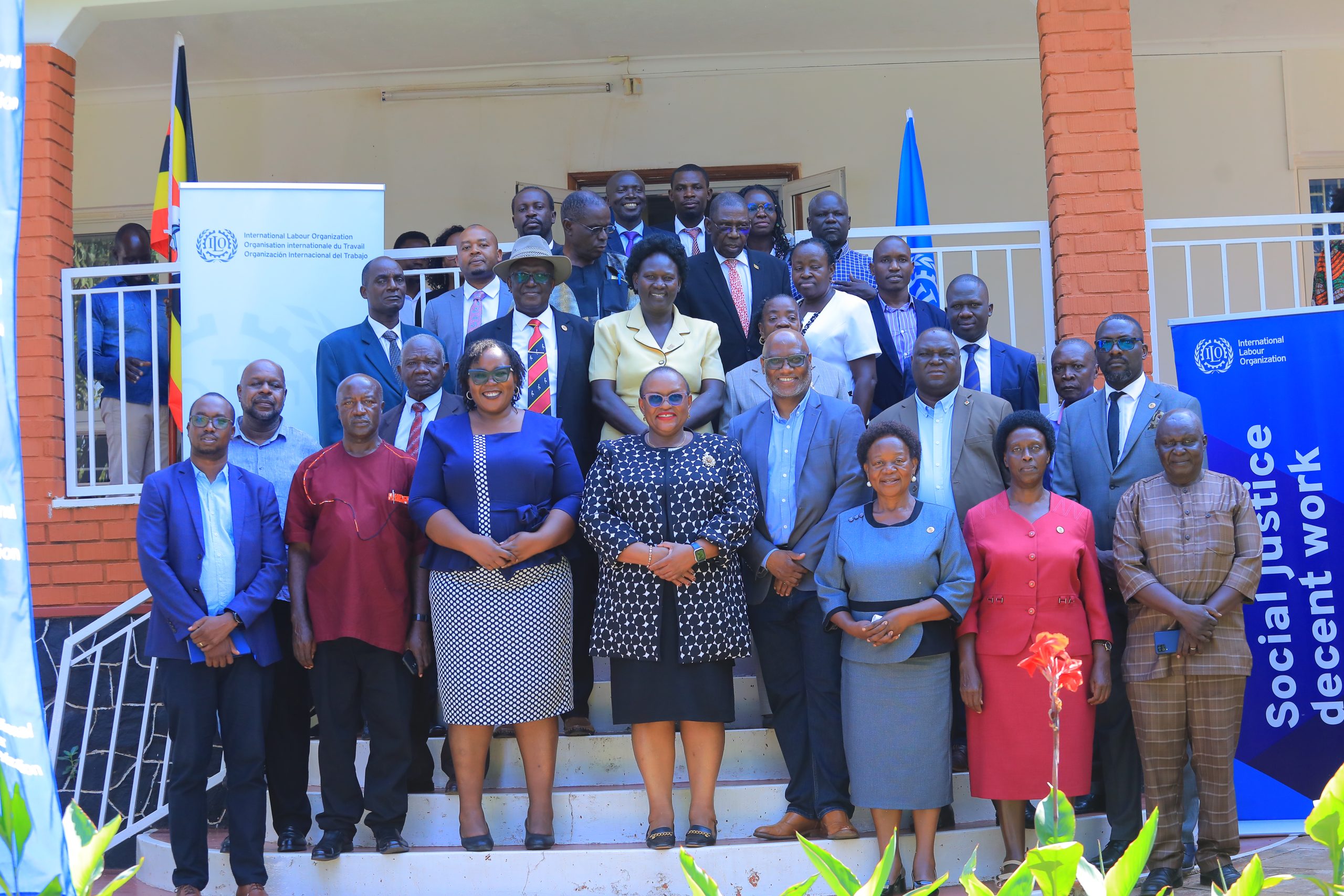
The International Labour Organization (ILO) has today, Friday, 13 September 2024, held a significant handover ceremony at its headquarters in Kampala, marking a major milestone in Uganda’s journey toward digital transformation in labour justice and the strengthening of workers’ rights.

The event, presided over by Ms. Caroline Khamati Mugalla, Director of the ILO Country Office for the United Republic of Tanzania, Burundi, Kenya, Rwanda, and Uganda, marked the official handover of key items from various ILO projects aimed at enhancing Uganda’s labour sector. The Items included; a vehicle, tablet computers, Logistics Management Information Systems (LMIS) Servers, and copies of the 7th Edition of Laws Compendium of Uganda.

This handover represents a critical step toward ensuring that all workers in Uganda, including the most vulnerable, can access swift and just resolution of labour disputes.

“The ILO remains committed to strengthening the systems that uphold workers’ rights and ensuring that we empower national institutions to deliver justice more effectively,” says Khamati Mugalla.

Digitalization of the Industrial Court, by the ILO PROSPECTS Project

As part of the ILO PROSPECTS project promoting refugee and host community livelihoods, the Industrial Court of Uganda is undergoing a comprehensive digital transformation to enhance efficiency and access to justice for both refugees and host communities. The initiative aims to modernize the court’s operations and address longstanding challenges, ensuring swifter and more transparent resolution of labour disputes.

The handover included the provision of notetaking computer tablets to key judicial officers and panelists representing workers and employers, facilitating improved court sessions. Hon. Justice Linda Lillian Tumusiime Mugisha, Ag. Head Judge, Industrial Court, expressed optimism that the digital tools received will significantly enhance the court’s ability to process and resolve cases in a timely, fair, and transparent manner.
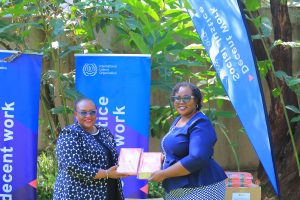
Ms. Caroline Khamati Mugalla, Director of the ILO Country Office for the United Republic of Tanzania, Burundi, Kenya, Rwanda, and Uganda hands over, the newly revised 7th edition of Uganda’s consolidated laws to Justice Linda Lillian Tumusiime Mugisha, Ag. Head Judge, Industrial Court.

Moreover, efforts are underway to implement technological upgrades based on a comprehensive assessment of the court’s digital limitations. The ongoing digitalization process is currently focusing on key court halls in Kampala, Mbarara, and Lira, with the goal of reducing case backlogs, streamlining legal research, and enhancing the efficiency of the judicial process.

Legal Compendium for the Industrial Court, by the ILO CAPSA Project

The ILO, through the CAPSA project, provided the Industrial Court with the newly revised 7th edition of Uganda’s consolidated laws. These legal resources are vital in ensuring that the court’s decisions are accurate, credible, and based on the most current legal frameworks. This initiative is expected to significantly improve the court’s ability to process cases and promote a more transparent and fair legal process for both employers and employees.

“These updated legal resources will be instrumental in ensuring that the decisions made by the Industrial Court are both efficient and credible. The consolidated laws allow our judicial officers to work with the most up-to-date information, eliminating delays caused by outdated references,” says Hon. Justice Linda Lillian Tumusiime Mugisha.

Labour Management Information Systems (LMIS) Digitalization, by the ILO Better Regional Migration Management (BRMM) Project

In collaboration with the UK Foreign, Commonwealth and Development Office (FCDO), the ILO is supporting the Better Regional Migration Management (BRMM) project, which seeks to strengthen the capacities of countries in East and Horn of Africa to govern labour migration through evidence-based policies.

The BRMM project in Uganda is focused on developing a Labour Management Information System (LMIS) to enhance the governance of labour migration and improve migrant workers’ qualifications and skills while engaging social partners.

“The new LMIS servers will transform how we collect, manage, and analyze labour market data. This will not only benefit the Ministry but also all stakeholders in Uganda’s labour sector, as we can now deliver more responsive and evidence-based services to employers and workers,” says Aggrey Kibenge, Permanent Secretary, Ministry of Gender Labour and Social Development.

The ILO’s initiatives in Uganda align with the organization’s broader commitment to promoting decent work and ensuring that workers, including those in vulnerable situations, have access to fair and timely labour justice.

Vehicle to Support Workers’ Rights Advocacy across Uganda:

In addition to the digital equipment and compendium, ILO handed over a vehicle to the National Organization of Trade Unions (NOTU) to support their operational capacity. This vehicle will enable NOTU to expand its outreach efforts and continue advocating for workers’ rights across Uganda.

ILO and NOTU have a longstanding partnership, working together to protect and promote the rights of workers in Uganda, particularly those in the informal sector. The provision of this vehicle underscores the ILO’s commitment to strengthening institutions that advocate for decent work and workers’ protection in the country.

The vehicle was received by Richard Bigirwa, the NOTU ,Secretary-General. “With this support from the ILO, we are now in a stronger position to reach more workers across the country and ensure that their rights are protected. This vehicle will help us to extend our efforts in promoting fair labour practices in even the most remote areas,” says Bigirwa

Ms. Caroline Khamati Mugalla, Director of the ILO Country Office for the United Republic of Tanzania, Burundi, Kenya, Rwanda, and Uganda hands over the vehicle to Richard Bigirwa, the NOTU, Secretary-General.

The handover ceremony marked a critical moment in Uganda’s journey toward enhancing labour justice and strengthening workers’ rights. By providing digital tools, legal resources, and operational support, the ILO is helping to create a more efficient, transparent, and fair labour system that benefits all workers, including refugees and those in the gig economy.

Related

Out to Lunch

#OutToLunch: Some of the big bets for 2026

By Denis Jjuuko It was just the other day when many people were making resolutions for 2025. Days turned into weeks, months and now a whole year. You blink, and it is a new year. I hope that you managed to achieve those targets you set for 2025. If you didn’t, well, you can still list them for 2026 and work on the issues that made you fail to achieve them. Well, there are so many things that are happening in 2026. An election is upon us and it comes fast—starting on 15 January. I hope that your candidate wins and most importantly that they do what they are promising to do. In the meantime, I thought of a few things that could be important in 2026. They could be business ideas or stuff that may make your life better one day. Generators, power back up As I was writing this, a close friend called me and she sounded desperate. Her electricity had failed and she was worried about spending yet another night in darkness. She had bought an inverter but because of a prolonged power shutdown in her residence area, her batteries were drained. She fears darkness. So, she thought I could be a plug for a standby generator for a night. We made frantic phone calls but many people with generators for hire had closed for the night. Anyway, it reminded me of a visit I made a few months ago to a friend’s home. I found people installing a generator. My friend had rightly predicted that the transition from one electricity distributor to another wouldn’t be that smooth and had envisaged the return to darkness. I had thought that he was panicking. He wasn’t. The new distributor has told us that electricity will stabilize in a few years. So, in 2026, either get a standby generator for your home or business or start dealing in them. Water harvesting When electricity fails, the guys at Katosi and Gaba inform us that they can’t pump water from Lake Victoria. This means that the taps soon run dry. When we were younger, we used to ask ourselves a silly question. What would should we rather have? Running water or electricity? We thought we had left those days more than 20 years ago. And it seems the question wasn’t even silly after all. So, what would you rather have in 2026? Water or electricity? Well, in 2026, either get a water tank for rain harvesting or start dealing in them. Car parts The smart guys at the Ministry of Works and Transport have declared a mandatory vehicle inspection at your cost. Not a bad thing if it would make our roads safer. But if you live in some of these parts of Kampala, most likely your car won’t pass the test. If it does, it will not be in a good shape a few days later. Some of the roads in Kampala have the biggest potholes ever seen in the world. If you drive a car that was once owned by somebody in Asia or Europe or north America and got rid of it by selling it to you, be prepared for a new suspension every few weeks. You may also have to budget for a bumper in 2026. If you live in a neighborhood with a paved road and potholes aren’t your problems, well, still budget for some body parts. However much you rivet your car, guys will still pluck off stuff in traffic jam or they will scale your fence and “undress” your car. So, in 2026, plan for car spare parts or start dealing in them. Coffee and gold Coffee and gold are most likely going to continue being top forex earners for Uganda in 2026. You may have to look for ways to get involved. Gold, though, has expensive school fees, so invest with care. Coffee, some call it the green gold, is a bit easy. Entry fees are not so exorbitant and many people have knowledge of how to grow it, trade it or drink it. If growing it is where you want to start, think of some bit of irrigation. Changes in the climate are real but also water in Uganda is easily available in many parts where coffee is grown. A few feet underground, and there is reliable water all year long. In 2026, find a way to deal in coffee, remember “it doesn’t lie” or even gold if you have the school fees. The writer is a communication and visibility consultant. djjuuko@gmail.com

Read More »
Out to Lunch

#OutToLunch: How Uganda’s next president could easily reduce the housing deficit

By Denis Jjuuko It is not uncommon to find a social media post in Uganda regarding the price of land or property being shared many times. The argument is that land prices are extremely high especially around Kampala and in many major cities or towns across the country. With an ever-increasing population and poor infrastructure and services a few kilometres outside these major urban centres, it shouldn’t be entirely surprising that land is expensive. I have always given an example of Mpigi town, which is nearer to Kampala than Entebbe but a difficult place to commute due to poor infrastructure. Yet with the Entebbe expressway or even the old road, Entebbe is an easier place to access. So, land prices around Entebbe will always be high as not many people would make Mpigi their area of residence while working in Kampala. That though will change when the Kampala-Mpigi Expressway is complete. However, construction of infrastructure such as expressways in Uganda takes a very long time leading to people crowding around the urban areas where it is easier to commute to their workplaces and services such as hospitals and schools are better. This increases pressures on land for housing purposes in urban areas. And as the population grows, land, an inelastic resource becomes more expensive. Many young people end up struggling to build houses. With the current housing shortage said to be over 2.4 million units in Uganda, poor infrastructure and services and an ever increasing population, the price of land will only continue to rise unless the government does something. And that wouldn’t be nationalizing land like some people urge whenever there are delays in executing infrastructure projects or when the price of land is seen as a hindrance to young people owning houses. Government must realize that the most valuable asset the majority of Ugandans will ever own is a house. Once people own property, they wouldn’t want to create so much chaos that could lead to destruction. Empowering young people to own houses should therefore be in the government’s best interests. Since land in Uganda for housing is largely owned by private entities or communities who determine its cost without any guiding principles, government could create a land bank from which individuals could buy land or a house. How would this work? And since we are going to the polls next week, the country’s next president has his work well cut out. In urban areas like greater Kampala, government could buy large tracts of land in Mukono, Mpigi, Mityana and Luweero and demarcate it for planned housing estates similar with what private land dealers do but a bit better. Land would be divided into small pieces with architectural plans drawn by leading experts. Schools, recreation, and health facilities would be planned. The government would then sell the land at a rate lower than the private sector. Nobody would be allowed to deviate from the architectural plan. If you bought in an area with bungalow houses, you build the exact bungalow. If you bought in an area for storied villas, you build a storied villa as per the architectural plan. Each person or legally married couple would be allowed to buy only one plot and you can’t sell it to another person at any rate. If a buyer prefers to sell, he sells it back to the government at the price he bought it. This would protect the land from speculators who buy, hoard and then sell at an exorbitant price. Because the cost of building a house with a given architectural plan is easy to establish, banks would only rent a certain amount of money. Banks willing to lend the money would not give it to the individual as is usually the case, rather a prequalified construction company that can deliver the house within the established cost of building it with a capped interest rate or profit. This is how Islamic banking works and therefore not a novel idea that is difficult to implement. Should a person fail to pay, the government buys it from the bank at the set amount and then sells it to somebody else. People could pay in installments over a given period. Monthly deductions could be made to salaried workers such as civil servants interested. The government can then construct roads and expressways to those areas as many people would be living in these housing estates. Public transport, schools and health facilities would be prioritized. More young people would end up owning houses and therefore a huge stake in their country and ministry of urban planning would have something big to deliver. The price of land for housing would plummet too enabling more people to own houses. The writer is a communication and visibility consultant. djjuuko@gmail.com

Read More »
Out to Lunch

#OutToLunch: Replicate innovation hubs in Kampala and refugee settlements across the country

By Denis Jjuuko Airpods in the ears. Hands busy with a smartphone. Shoulders holding a leather laptop carry bag. Legs covered in sagging pants. Torso well covered in a jumper with a hoodie. Hair spiked. Sunglasses on. It is a familiar sight at a building in Kampala where young people trying to replicate Silicon Valley converge to work on largely fintech applications. At least a floor in the building provides open spaces where these people work on their ideas while sipping iced coffees sold at a cafeteria in the corner. Walls are covered with inspiring graffiti of quotes by famous people or even bible verses. The young people are on a mission to make it big in the tech world. Those who find some breakthrough, which usually means nailing somebody willing to invest in their ideas or provide a grant, move to the office cubicles partitioned with glass, providing more inspiration to those still on the journey. These workspaces have many names. Incubation centres, ideation labs, entrepreneurial hubs, job centres. They are usually funded by development partners as a way of subsidizing the cost for these emerging entrepreneurs, developers, inventors, creators or whatever they prefer to call themselves. Perhaps having seen some impact in urban areas, these centres were replicated in many of Uganda’s refugee settlements across the country. At these centres, youthful refugees and host communities access high speed internet, get access to computers and sometimes machinery and tools that enable them to bring their ideas to life. The development partners sometimes throw in training like how to use multimedia platforms to market their businesses or find work. Small grants for groups with innovative ideas or even for those who are dedicated to their work are common. Access to high-speed internet has helped a few of them to create great products. On a visit to the Nakivale Refugee Settlement, I found an interesting group that makes guitars. They taught themselves via YouTube tutorials and they are able to market their shiny guitars to global customers through social media. They have been supported by Partnership for improving prospects for forcibly displaced persons and host communities (PROSPECTS), a project implemented by the International Labour Organization and funded by the Netherlands. It is remarkable what young people can do once they are enabled to innovate. Skilling is critical not just in vocational jobs. But also, in soft skills such as communication and digital marketing. How can they use WhatsApp Status, YouTube or TikTok to push their products out? How can they use YouTube to learn a new skill? I don’t think there is a vocational school that sets itself out there to teach making guitars but those refugees in Nakivale found a niche and made it work even though they have a long way to go. I have heard of people who taught themselves baking, weaving, and a few other things via YouTube tutorials and are now earning a living and even employing others. Once young people have access to affordable internet, many can teach themselves similar skills once they appreciate what they can do with a smartphone. Multimedia skilling programs for youth such as those offered by the Uganda Communications Commission (UCC) through Uganda Communications Universal Service and Access Fund (UCUSAF) are a good starting point. I have seen people learn making professional posters through platforms like Canva or videos using CapCut thereby joining the creator economy. I think there is a need to replicate the incubation hubs in Kampala and job centres in refugee settlements at subcounty level or even district level to start with. Here, young people would converge even if once a week to discuss with like-minded individuals, teach themselves skills and form partnerships and synergies that would enable them to scale their ideas or enterprises. Of course, regular trainings and mentorship would be important. They would be able to access high speed internet, computers or virtual reality gadgets. They would also test out their ideas and over time have access to those who may have been able to succeed. They would also provide markets to themselves. If one has mastered digital marketing, another involved in another industry would be able become their customer. We have also talked about value addition for a long time. Machinery is expensive. Knowledge is scarce. If people grow some coffee in Bukomansimbi or Budadiri and you want them to add value, a roastery can be installed at this hub where those interested can roast and package their coffee. As they grow, they would be able to scale on their own. If the hubs are somewhat working for youths in Kampala and refugee settlements, they can work too in rural communities. The writer is a communication and visibility consultant. djjuuko@gmail.com

Read More »