
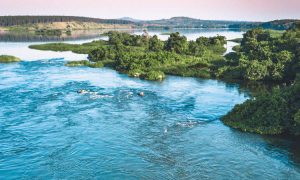
River Nile

Out to Lunch

#OutToLunch: Had Iran been Uganda, what would we have done?

By Denis Jjuuko When the planners of the war on Iran sat to make the final decision, they perhaps envisaged a quick win. Fly in, kill the leader and a few others and the country would collapse. Your chosen leaders would then take over and pledge allegiance, after all you are the world’s super power. Oil would flow to wherever you want it. As the leader of America, Donald Trump would be expected to stand somewhere in the White House and announce how the greatest military on Earth has performed. The new leaders in Tehran would repost his every post. A red carpet would soon be rolled out at the White House where the new leaders in Tehran commit to pay allegiance to the Americans and their Israeli backers. Washington would announce the end of sanctions and beckon American companies to take on the reconstruction of Iran. A date for a return visit to Tehran would be announced. Donald Trump would step on the improvised steps of Air Force One and utter the word ‘freedom’ while clenching his fist. At a speech in Tehran where school kids are waving paper flags of Iran and USA, he would warn others of what will come if they don’t fall in line. Fox News would declare him the greatest leader America has ever had. Trump would demand the Nobel Prize committee to award him. He has saved the world of potential nuclear weapons. Hollywood writers would scramble for pieces of paper to script a blockbuster. However, Iran seems to have had different ideas. The writers must now be writing but not the grand movie. American contractors are waiting, unsure when their reconstruction deals will be inked. Trump posts one thing after another, perhaps once in a while, remembering the famous quote from Sun Tzu’s the Art of War: the best way to win a war is not to fight. Iran defied the odds. Two military powers have dropped thousands of bombs on its facilities and leaders but it has been able to somewhat fight back and even forced ceasefire talks in Islamabad, Pakistan even if they ended without any deal. When you think of Iran, you always want to think of Africa or at least one country in Africa since the continent is not homogenous. Is there one that can stand up to the world powers? Perhaps none. Our natural resources are not used strategically. In fact, they have been a source of endless wars. Look at the Democratic Republic of Congo for example. I consider them the richest country on earth but they can’t even complete their Inga Dam or construct bitumen standard roads. Uganda, a potholed nation, is helping them in the eastern parts of the country. Nigeria had to wait for a private person to build a mega oil refinery. They preferred to export crude and import the refined products. If an individual businessman can mobilize resources and build a refinery, what about a country? And you can say that about all oil producing countries on the continent. We have conditioned ourselves to export raw materials and import everything. The Iranians didn’t wait to import everything. They made their Shahed drones, they developed their missiles program and created a system that wasn’t depending on a single strongman whose assassination would lead everything to crumble. They built universities and given that they are forcing Americans to sit on a negotiation table, it means they didn’t fill their key positions based on blood relationships or who could praise their leaders loudest. They also understood leverage. Their location provided them with the Strait of Hormuz through which 20 percent of the world oil passes. They understood that 20% of the world’s oil can’t be ignored. They understood that their location gives them an opportunity to fight back or take the war to the enablers of their adversaries. They didn’t spend half their time blaming the Americans for the economic sanctions imposed on them. They found a way to prepare themselves for a war that they knew that one day would come. Had the Iranians been some of the African leaders, they would be blaming colonialists while sending their kids to western universities and keeping whatever money they land on in Swiss banks. Research and development would mean nothing. The most energetic labour force would be carted off to find jobs as domestic workers while being urged to save and come back and be job creators. Had we been Iran, how would we be strategically using River Nile, Lake Victoria, the near perfect weather we sing about and all the resources we have? The writer is a communication and visibility consultant. djjuuko@gmaio.com
Read More »
Out to Lunch

#OutToLunch: Incentives could further switch on West Nile for investment

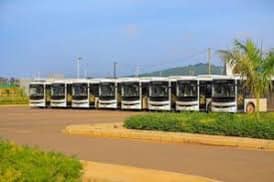
#OutToLunch: Incentives could further switch on West Nile for investment By Denis Jjuuko On my first visit to Arua in West Nile, many years ago, my colleagues and I decided to unwind by visiting a nightclub or something similar to it. We were young and free. We had made the long trip from Kampala, rested a bit and decided to indulge in the night, enjoy some Lingala and whatever a bustling border town has got to offer. I had seen a huge electricity generator station by the roadside, a few minutes to Arua town but hadn’t paid much attention to it. I had also not done much research about the city’s night life. It was one of those days you jump into a car, drive to a town, get some accommodation and you are ready to go. A journey to discover the unknown. Some people call it adventure. In the nightclub, I noticed something strange. As a self-confessed nocturnal at the time, I had been a ‘happening’ boy by some lousy standards. I had also worked in journalism and the entertainment sector had been part of my beat. At university, I had enjoyed the exuberance of youth through clubbing. Nightclubs, therefore, were not strange to me. In Arua, at that nightclub, everyone had a torch. If you are considered old in Uganda, you remember the silver metallic ones with a red button on the side. Those were for the sophisticated ones. Those who lacked means had plastic ones. The only revelers who didn’t have either a plastic or silver metallic torch, were my colleagues and I. The majority of the people pulling all dance strokes on Lingala music were partly ‘giving us the eye.’ Like in most places, you could tell that people realize you are a foreigner. You don’t understand the rules. I became more cautious and decided not to indulge much and be more of a casual observer, with one eye on the exit door. Sooner than later, I realized why everyone who knew Arua well had a torch. At the peak of people’s enjoyment, electricity was switched off. The entire town went dark and quieter than a cemetery! Again, if you are considered old in Uganda, loadshedding is not something new to you. Electricity was always shared. If you had power today, you didn’t have it tomorrow. Rationing. But loadshedding in most parts of Uganda at the time meant power was switched off in the early evening around 6.00pm and switched back on around 10.00pm. In Arua, power was being switched off after 10.00pm. Strange loadshedding. Once power went off, the nightclub didn’t have a generator powerful enough to enable the rotating multicolor disco lights to be switched on. The nightclub’s standby generator was only big enough to power the sound system. That is why the revelers had torches. They switched them on. Some pressed the red button on the switches which made the torches provide a blinkering light. Others tied them on their waists. As they pulled those rare dancing strokes that are synonymous with Congolese across the border, they provided a spectacular experience akin to that of customized dazzling disco lights. What a spectacle! The ingenuity of the West Nilers. I have made hundreds of trips to Arua since that night and definitely power had become a bit reliable. But it is only the other week that West Nile was switched to the national electricity grid. It is a remarkable achievement or a shame that it has taken this long depending on how you look at it. The region has unbelievable potential given its location at the borders of both the Democratic Republic of Congo (DRC) and South Sudan, some of Uganda’s biggest trading partners. Both countries are expansive and a big chunk of their populations rely on cities like Arua as the source of their goods and services. I learnt that some of those guys who were rivaling Congolese dancers in that nightclub were actually Congolese who cross the border to enjoy life. Anyway, both countries also suffer regular insecurity which means investors will always keep away apart from those exploiting the countries’ massive natural resources. But the investors could not set up businesses such as factories in Arua, to supply West Nile, DRC and South Sudan and beyond. They would rather set up in Kampala or Jinja where electricity was not such a big challenge. Yet if they set up in West Nile, they would be nearer to the market. Lack of electricity was always the challenge. Now that the problem is sorted, West Nile’s potential should now be fully exploited. West Nile is also very diverse with many different cultures, which can be a bedrock for non-animalized tourism. Even the alleged world’s smallest church is in West Nile! Nang Nang, perhaps the world’s tastiest fish is available in basketfuls. The River Nile cuts through the region, providing near perfect locations for riverside resorts and water sports. Land is still relatively affordable and fertile and some of the major towns are being connected by bituminous standard roads. Small planes can land in Arua. For those who love animals, Murchison National Park is partly in the region. Affordable trainable labour is in abundance. Electricity also means companies like Kiira Motors can now set up shop for electric buses. Or investors can think of electric vehicle chargers. An electric bus trip from Kampala to Arua would cut the cost by more than 50%. Major urban centres like Arua being border towns have populations with some bit of disposable income. But investors will need to be mobilized and incentivized so that they can set up shop. For those responsible for the country’s development, their work is now well cut out. Those selling torches, if they still existed, will have to pivot. The writer is a communication and visibility consultant. djjuuko@gmail.com

Read More »