
Kakira

Out to Lunch

#OutToLunch: Municipal bonds could help resettle kiosk businesses removed from road reserves

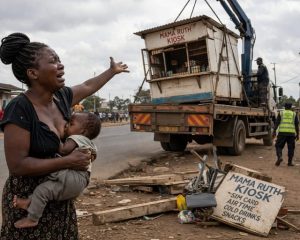
By Denis Jjuuko A few weeks ago, the internet in Uganda went gaga with a photo of a woman raising her hand, while another holding a toddler who was busy breastfeeding. The woman was in distress as her kiosk was being loaded on a truck with Kenyan motor registration license plates. People said it was photo of the year. To be honest, it is a very powerful image and lives to the axiom that a picture says a thousand words. Some people offered to help the woman. Others said a lot of stuff about the ongoing countrywide campaign to remove informal structures from road reserves and elsewhere. The photographer was the “most wanted person.” It turned out the image was made through prompting artificial intelligence applications. What AI won’t do!! Anyway, Uganda is one of those countries where everyone is either a business owner or trying to start one or has ever started one. We are labelled, by some international organisations, the most entrepreneurial country in the world. But most of our businesses are small, micro small or something lower. A kiosk here, a stall there, a bench where you can polish and shine shoes or simply sit and wait for customers and sell them something that you pick from a shop that you pretend to own. It is called kuyiriba in Kampala speak. With the coming of age of the internet, kuyiriba is also very much alive online. However, kiosks and stalls on streets, road reserves and everywhere you turn, although a big source of employment in the informal sector, are also an eyesore. They create a slummy and unsafe environment for both the people who own them and their customers. The government decided that it had seen enough and instructed their removal (though that order has since been halted). Imagine you are driving on a highway that connects Uganda to Kenya, and perhaps the busiest in the country given our reliance on the Kenyan port of Mombasa, and all of sudden you see hundreds of stalls selling waragi between Kakira and Magamaga where largely taxis and trucks stop, “recharge” and continue to wherever. What message would visitors to Uganda through that route be thinking? Drink driving makes our roads unsafe. What about those visitors who were using the old Kampala-Entebbe Road? They give an impression of a very poor economy. Most of the remaining shops won’t do us any justice either. Impression is sometimes everything. In the meantime, I hope they can ask the property owners to at least pave their front yards and apply some fresh coats of water-resistant paint. The aging roofs could be replaced too. Those who can’t improve these properties could be asked to sell them to those who can. Alternatively, government can acquire them through fair compensations, similar way they do with the right of way while constructing roads. The government would then make a masterplan of the area complete with architectural plans and invite those with money to buy the land from the government and invest. The new investors would not be allowed to change the plan to whatever they want. The government would get the money by issuing municipal or infrastructure bonds. Saccos and investment clubs, individuals and others players would oversubscribe. And then they would find the money to buy the masterplans and do the investments in record time. Tax incentives could be provided. The masterplan would include acquisition of large areas where markets would be established so the kiosk and stall owners would be shifted there. Flea and mobile markets would also operate in such areas instead of doing so in road reserves. Taxi and bus stop areas would be identified and even future train stations. Cycling lanes in some areas as well. Kampala and many upcoming urban areas don’t have open areas. This way, some areas would be dedicated to that among other amenities that make cities livable. Ugandans would have to accept that they can’t get whatever they want around the corner. Every little corner can’t be boda stage or taxi park or a temporary eatery every 7.00pm. People would have to learn to walk or even drive a bit for what they need such as boarding a taxi or getting some groceries. Every little front yard can’t be a kiosk or boutique of used dresses. The global cities we admire are designed that way. We have the tools to do that. The writer is a communication and visibility consultant. djjuuko@gmail.com
Read More »
Out to Lunch

#OutToLunch: How Kikuubo can transition from trading to manufacturing

By Denis Jjuuko A few weeks ago, I was invited for a meeting in Jinja, which is about 80km away from Kampala. In order to make a small saving, I decided to drive with a friend who was also attending the same meeting. Our meeting was scheduled for 10.00am. We decided to leave Kampala at 7.00am in order to make it to Jinja in time. We thought that two hours were enough to cover the distance. Because my friend lives around Bweyogerere and it was early morning, we didn’t anticipate any difficulty in being in Jinja well ahead of the scheduled time. We decided to use the main Kampala-Jinja Road instead of the one through Kayunga that I normally prefer. Afterall, my anticipation was that we would be driving against traffic as the majority of people who live in Mukono would be coming into Kampala. The traffic was instead bumper to bumper in Namanve and Sseeta and we thought that once we go beyond Mukono town, we would be able to move faster. We continued our drive and along the way we started realizing that we could not make the trip by the scheduled time. We arrived in Jinja about 15 minutes late. I remembered this while watching clips from a meeting between the president and the traders who are protesting the tax system. The president advised them to become manufacturers instead of importers of finished products. If you are a regular reader of this column, you would know my position on manufacturing. I am an advocate because there aren’t many countries that developed without focusing on manufacturing. Through manufacturing, countries are able to employ large numbers of the working age population. Manufacturing ensures sustainable jobs with predictable regular income, a prerequisite for economic growth and wealth accumulation. When people have a regular predictable income, and not depending on chance, they can be able to invest in long term projects such as housing. Banks can offer low interest long term e.g., 30-year mortgages. Business people would invest in sectors for long-term knowing there are people who will be able to afford their products or services. When the majority of people’s incomes depend on prayer and the intercession of the holy spirit, investors keep away. The people can’t save. You can’t save what you don’t have. Banks, instead of lending money for business, they focus on lending to the government. They are nearly sure of being paid back than when they lend to businesses who don’t have an assured market. Anyway, if Uganda is to become a manufacturing hub as the president wants it to be, there are certain things that government must put in place. One of them is the highway not only to Jinja but to the Kenyan border. There are plans to build the Kampala-Jinja Expressway but they remain largely plans todate. If you are a regular user of the road beyond Jinja, you know that jam builds up between Kakira and Iganga (Kakira and Jinja is smooth because it is a four lane road). Maybe the Kampala Jinja Expressway should become Kampala-Iganga or even Malaba Expressway. If people are spending 3-4 hours to cover a distance of about 80km, like we did for the Jinja meeting, it will become costly for manufacturers as this is the main route for their raw materials and finished products (to the port of Mombasa). But even if the road was wide and smooth, road transport is expensive for manufacturers. Railway transport provides solutions but plans about the Standard Gauge Railway (SGR) became a mirage. Yet at one stage we had a railway line that almost connected all the major parts of the country. We also have Lake Victoria; it can solve some our bulky transport woes. The majority of Ugandan traders start after dropping out of primary or secondary school. They learn trading and after a few years of frugality and tenacity, they make it big. They will never invest in stuff that are not tangible such as research and development (R&D) which is key if any country is to become a hub. What most traders know is that if you pay this amount of money, you get this amount of goods and sell them at that amount of money. That is why EFRIS is a big issue yet maybe it shouldn’t. Government needs to appreciate their strengths and limitations and invest in R&D on their behalf, showing them which sectors or products, they can invest in as manufacturers and handhold them until when they can transition from informal traders to manufacturers. It can match them with foreign investors for joint ventures and most importantly for technology transfer and support them on issues such as corporate governance. There are already traders in Uganda who have made this transition, how did they make it? It is the story government should be telling while dangling the investment incentives traders need to make the transition. The writer is a communication and visibility consultant. djjuuko@gmail.com

Read More »